Showing posts with label history. Show all posts

Sunday, February 16, 2025

Augustus Caesar's World (Foster) & The Story of the Romans (Guerber/Miller)

 The readings for this post are for my Greeks & Romans class tomorrow. I have read these chapters in previous years but, as it is a good idea to do, I read them the day before class to refresh my memory and make note of anything I want to be sure to highlight. We do reading in class, followed by narrations, and then they read the rest during the week and submit written/recorded narrations. 

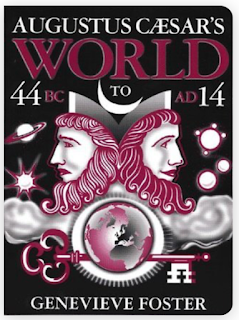
In Foster's book, I am reading pages 186-194, "The Law of Moses" and "Augustus, the God." 
The Torah, or the Law of Moses, was an old book containing the first five books of the Bible. It was written even before Virgil wrote the Aeneid. It was written after the Jews were exiled to Babylon. Those who were afraid that their history would be forgotten gathered all that they could of the tales, myths, legends, stories, songs, and psalms that had been passed down, and compiled them into a Bible. It told how time and again the people who had turned from God were brought back by the prophets to worship the one true God. Their ideas of what God was like changed over time.

Before the time of Babylon, when the people thought of God as righteous and just, they thought of Him as vengeful and directing them into battle against their enemies. Before that they thought of Him as one of the many spirits of the desert. Before that they made sacrifices, even of their firstborn children and later the firstborn lambs, to whichever spirit of the desert was popular.

As time passed, these people moved from one place to the next and encountered the Phoenicians and Canannites. They worried that their spirit gods were not as powerful as the foreign gods and so began to worship and sacrifice to them instead. It was when in Egypt, still worshipping other gods, that Moses came to direct them back to the true God. 

Moses led the people out of Egypt to Mount Sinai where they encountered God, Jahveh, whose power could be seen by a pillar of smoke by day and pillar of fire by night. They were to have no idols and an ark was carried with them wherever they went for the spirit of God to be with them as they traveled. 

The next portion goes through the books of Genesis-Deuteronomy. I will say that there are some inaccuracies in her recounting of the Torah writings.  

In the beginning God created everything. On the sixth day He created man. After the Garden of Eden was ready and man placed in it, God took a rib from man and created woman. The woman was beguiled by a serpent and ate of the forbidden Tree of Knowledge of Good and Evil (Foster says Tree of Life). Because of this disobedience, God exiled Adam and Eve from the garden, condemning Adam to till the ground until he returned to it.

Eve bore sons to Adam; Cain, tiller of the ground, and Abel, keeper of sheep. After a while, Cain killed Abel. Cain was then sent far away, a "vagabond on the earth forever."

There were more people born and eventually they were all evil so God decided to destroy them with a flood. He told Noah to build an ark and to take his wife, sons, and their wives into the ark, along with "every living thing went in two by two." (That's wrong also; seven each of the clean animals and two each of the unclean were taken in the ark.) After this was done the ark was sealed and the rain fell for forty days and nights. Eventually the land dried out and Noah and his family went out of the ark. The Lord said He would never again "smite the earth as I have done." Noah and his sons, Shem, Ham, and Japeth, were told to be fruitful and multiply. 

One of Shem's descendants was Abram. Abram was of Ur of the Chaldees but God told him to leave the land of his father and go where He would tell him. If he walked rightly then God would bless him with abundance and "thy seed after thee all the land of Canaan for an everlasting possession." When Abram was 100 years old he had a son, Isaac.

Isaac had two sons, twins: Esau, a skillful hunter, and Jacob, man of the field. Later in his life, God told Jacob that he would no longer be called Jacob but Israel. Israel's sons were twelve but he loved Joseph most and made a coat of many colors for him. Joseph's brothers were jealous and hated him. They sold him to merchants on their way to Egypt.

In Egypt, Jospeh, though a slave, became the overseer of Potiphar's house and all that he had. Foster omits many details, but next we are told that Joseph saved up food for seven years so that when there was a famine in the land, only Egypt had stores of food, so people from all over came there to buy. Some of those people were Joseph's brothers. He knew them when he saw them, but they did not recognize him. When he told them who he was, he bade them bring Israel and all he had to Egypt. Joseph died in Egypt.

Time passed and a new pharaoh rose up in Egypt who did not know Joseph. As the Israelites were getting to be "more and mightier" than the Egyptians, he became oppressive to them. He demanded they make bricks. Also, because of their numbers, he commanded that all male Hebrew babies were to be killed. Of course there was a male born to a Hebrew of the house of Levi. His mother hid him until he got too big to hide, so she made a basket of bulrushes and set it adrift in the river. She had his sister, Miriam, watch over him. After a while, the daughter of Pharaoh came down by the water and found the baby. She named him Moses and raised him as her own. 

I am going to kind of summarize the rest of this chapter (that's not how a narration should go). Moses killed an Egyptian and then was sought by Pharaoh. Moses fled to Midian. He became a herder of flock and went to the land of Horeb, "the mountain of God." Here he saw the burning bush and was told that he would be sent to deliver the people from the Egyptians.

Skipping all of the plagues, Foster then moves to the Passover; the Israelites were to mark their doorposts with the blood of the lamb. The angel of the Lord "passed over" those houses, but smote the first born of every other house. Pharaoh let the people go, but then changed his mind. The Red Sea was divided; the Israelites walked on dry land through it; but the Egyptians were drown when they tried to follow. 

At Sinai, Moses went up the mountain where God gave him two stone tablets with the Ten Commandments: 

  1. Thou Shalt have no other gods before me; 
  2. No graven images;
  3. Do not take the name of the Lord in vain;
  4. Remember the Sabbath;
  5. Honor thy father and mother;
  6. Do not kill;
  7. Do not commit adultery;
  8. Do not steal;
  9. Do not bear false witness;
  10. Do not covet.

Leviticus, Numbers, and Deuteronomy are more laws given to the Israelites. Moses was shown the promised land that the Israelites would go into (the land of Canaan) but he wasn't allowed to go. He died in the land of Moab. 

(Perhaps a case of "read the book" and not just about the book! So much was omitted by Foster.)

Next Chapter: "Augustus, the god"

August, 12 B.C., Augustus was made a god of the Romans. An altar was erected and it was a glorious time. But the whole year was an eventful one! Agrippa had died; Julia was once again a widow. And she had four children, with another on the way. Augustus adored all his grandchildren: Gaius and Lucius (he'd adopted and made his heirs), Julia and Agrippina. But Julia was still young and he felt she needed another husband to keep her in check look after her. 

Augustus chose Tiberius to be her next husband, which was so sad for him, as he was already married! But he divorced his wife and married Julia. For a time it was fine but he was too sober and quiet for Julia, as she was wild and craved excitement. While he was away she surrounded herself with others who would lead her to a tragic end. 

Drusus, Tiberius' younger brother, was married to Antonia, daughter of Octavia and Antony. He had gone to Germany and crossed the Rhine, realizing his boyhood dream. In Germany, he built fortifications to protect against the German tribes and dug canals to the North Sea. 

In the year 12 B.C., Drusus was made governor of Gaul so he and Antonia went to live in Lyons. This place had been a great meeting place of the Druids; they held court every spring, settling disputes among the people. But the time of the Druids had gone and Roman law was firmly in place. Instead of their ancient gods, the Gauls were given Augustus Divus (Augustus, the Emperor of Rome) for their worship. Drusus built the first altar to Augustus Divus at Lyons and on the first day of August, 12 B.C. it was unveiled for all to see. A high priest was chosen and from then on, on August 1st, pilgrims were to come to worship. There were similar altars erected elsewhere in Gaul.

Making Augustus a god did not mean that the Romans looked at him as the God of Creation, but more like a saint; kind of like a saint of the Roman Catholic Church of today. He was the patron saint of the Roman Empire. It grew out of the old religion of Rome where when the High Priest died, the office was switched to Augustus, making him Pontifex Maximus. 

He did not allow altars to be erected to him in the city of Rome but they were built all around the Empire, and people bowed down to the altars. One group of people refused to bow down to this god: the Jews. They would pray for him but not pray to him. The first of their commandments was they would have no other gods but the One True God. 

The Oracle of Delphi

[Previously, the chapters talked about the king, Tarquin, seventh king of Rome.]

Tarquin was unhappy and he'd begun to have bad dreams. At the time, people thought that their dreams meant something about what was to happen in their lives. He asked the Roman priests to tell him what they meant but they couldn't. So Tarquin decided to ask the Oracle of Delphi. 

Delphi was a temple in the mountains for the worship of Apollo the sun god. A priestess named the Pythoness lived there and would converse with the gods, then passed this along to those who came seeking answers. 

Tarquin had murdered a nephew who had a brother but Tarquin had spared the brother because everyone thought him an idiot. His name was Brutus, possibly because of his "brute-like stupidity." But Brutus was not dumb at all; he was pretending and waiting his time for revenge. 

Tarquin sent two of his own sons to the oracle and sent along Brutus as an attendant. These gave the oracle the gifts from Tarquin and then decided to ask about their own futures. 

All three had brought gifts and the two sons' were rich indeed, but Brutus' was worth much more. He had given the staff he had traveled with; it was hollow and filled with gold! The answer given to the travelers' question of who would next be king was that he would rule who first kissed his mother on returning home. The sons thought that was easy enough and planned how to get home first. 

But Brutus, since he'd given a better gift, was given a hint by the oracle on what to do next. When they all got home, Brutus knelt down on the ground and kissed the earth, thus kissing the mother of all mankind. He had obeyed the command of the Pythoness without anyone being the wiser! 

The Death of Lucretia

The Romans did not like Tarquin because he was very cruel. But no one was strong enough to do anything. They were waiting for an opportunity and a leader. During the siege of the town of Ardea a group were having a disagreement about whose wife was the best. Collantinus said his wife, Lucretia, was the best. After visiting the houses of each, all agreed that Collantinus was right!

Sextus Tarquinius heard of Lucretia, who was a great wife and housekeeper, as well as beautiful. Sextus decided he must see her and so one night he left the camp of soldiers laying siege to the town of Ardea to visit her. He was a horrible man and "insulted her grossly." 

Lucretia sent a message to her husband and her father telling them to come quickly. When they arrived, she told them about what Sextus had done. It was so horrible that she said she had no desire to live any longer. Taking a dagger she'd hidden in her robes, she stabbed herself in the heart, dying at her husband's feet. 

Though it is wrong to kill oneself, or take the life which God has given, the Romans thought her very brave in this act. Collantinus and her father were speechless but Brutus, the supposed "idiot," removed the dagger and swore to avenge her death. Collantinus and Lucretia's father agreed.

Brutus had Lucretia's body laid out so that people could see "her bleeding side" and told them it was because of Sextus. He roused up the people who pledged to help him avenge her. They voted to drive out all the Tarquin family from Rome. Not only that, but they vowed to never use the word king again. 

Tarquin Superbus ran away to Etruria but Sextus went to Gabii, whom he had betrayed. The people of Gabii rose up and put Sextus to death. This was the end of the Roman monarchy, after about 245 years. Brutus was given the title of "Deliverer of the People."

The Stern Father

Even though the Romans had decided to not have kings they would gladly have let Brutus rule them. He would not do this and instead suggested they elect consuls. Of course the people chose Brutus, and Collantinus, as the first consuls. The government was called a Republic because it was in the hands of the people. 

When Tarquin heard that the Romans were building an army to fight him, he sent messengers into the city to "claim his land;" but really it was to bribe people to join his side. There were plenty of greedy men who would rather be under a bad ruler than the honest Brutus. Two of these men were Brutus' two sons. 

When they were found out, it almost broke Brutus' heart but he decided to make an example of them. They were tried for their part in the conspiracy to get Tarquin back on the throne. Brutus let them say their piece and if they were able, to deny the charges. But they could not. So Brutus said that they would be punished as if they were foreigners. They were executed and it was witnessed by Brutus who thought it better to die than live as traitors.

The people of Rome hated the Tarquins even more now and all relations of them were exiled from the city. Collantinus, though a bitter enemy of Tarquin, was related and therefore had to leave the city. The people voted for another Roman to be consul: Valerius. 

Tarquin then convinced the people of Veii to join his fight against Rome. Tarquin's army met that of Brutus' but when one of the sons of Tarquin saw Brutus, they rushed toward each other. They fought so furiously that they both died at the same time. The battle did not end there; both sides fought fiercely and by nightfall it was a draw. 

Brutus' body was carried back to Rome and a statue erected in the Capitol. 

There are four more chapters for the week's reading but I will stop my narration here. 

Wednesday, January 22, 2025

The History of the Ancient World- chapter 5 (Bauer)

 Previously in the Ancient World... to be absolutely honest, by using the "study guide" I do not recall anything from the second half of chapter four! I am a little disheartened that I retained nothing that I can recall from the last reading. (I will say now, which is after the fact, that I retained way more by doing a narration before attempting the questions from the guide.)

For today's narration, I am reading from chapter five, The Age of Iron, and I am not going to use the study guide until after. 

When the king of Kish was collecting tribute from those sailing up and down the Euphrates, and Memphis rose with its white walls in Egypt, the third great civilization of the ancient world was still just a string of fishing villages. It would be a while before India grew up!

Those in India were not list makers, city dwellers, nor did they carve their rulers' face on stone. They didn't put down their achievements for us to read so we don't know a lot about them from this time.

We can however look to the stories told thousands of years later. Though they were told so much later, they were most likely preserving an older tradition. There is one date in particular of interest from these stories: 3102 BC and a king Manu. ("And his age still has four hundred thousand years to go.")

Before 3102 shepherds and nomads traveled to India from Central Asia, through the Khyber Pass, or others may have come over the Himalaya themselves; skeletal remains shows it was just as treacherous then as now.

Coming down, they found warmth and water. The Himalayas acted as a barrier where in the winter it never dropped below fifty degrees. In the summer, the countryside was ablaze with heat. The two rivers (Ganga and Indus) kept it from being a desert. Snow melts from the mountains and runs into both the Ganga, which then runs into the Bay of Bengal, and the Indus. At one point she says there was another river, now long dried, that ran into the Arabian Sea. This caused the current Thar Desert to be just as green as the Sahara had been (read about this in a previous chapter).

After people had grown their first crops in the Mesopotamia and Egypt, others from the north were settling in the hills to the west of the Indus (today called Baluchistan). Villages sprang up along the five branches of the Indus river (called the Punjab- Five Fingers). Other villages formed along the Ganga. There have also been primitive tools like those in Africa of this time suggesting some were brave and made their way to India from there. 

But these areas of the south, east, and northwest have long been separated by many barriers. There are mountain ranges and plains. As time passed and the weather warmed, there stretched a vast desert three hundred miles wide. So from the beginning, these civilizations have lived independent of each other.

The villages near the Indus, to the northwest, grew into cities first. 

The first houses were built well above the flood line because like in Egypt, water meant life and death. 

This brings us to the first king of India. Manu V. (I do not recall his long name.) Before this king there were six semi-divine kings, all with the name Manu, and each with a reign longer than four million years!

According to the story- it can be understood to be myth but like other times, history and myth get intertwined- the seventh Manu (this would be Manu V.) was washing his hands in the river and a fish came up asking for protection from a bigger fish. Manu pitied the fish and saved it. 

The fish was safe and to repay Manu's kindness gave him a warning of a flood that would destroy. Manu built an ark and took abroad seven wise sages, known as the Rishis. When the flood past, Manu was in the ark on a mountain and became the first king of India. The Rishis were the seven stars of the Big Dipper. The year was 3102. 

However, this story is not set on a real firm foundation. There is less to prove Manu V. was legit, along with the date, though he was around the same time as the Scorpion King; there is more evidence for the Scorpion King. Because Indian history lacks definite dates, the fact that 3102 is rather precise attracts historians into latching onto it. ("being one of such improbable exactitude, it deserves respect." - Keay)

It is certain however that in 3102 villages along the Indus began to grow into towns. There were two-story houses, kiln-cured pottery was made, tools were devised out of copper. They were becoming less vulnerable to the destruction of water.

But even though there was prosperity, it seems that there was a time of decline rather than progress. This part gets a bit confusing because it tells of the ages having a spiritual connection, and the Iron Age was the most wicked of them all. There would be dishonesty, theft, greed, etc. "becoming slaves to their earthly possessions rather than free men who knew how to use the earth."

Based on the fact that these stories were told much later, it is probable that they were reflecting a more modern (she says mature) society where the state of affairs was a bit bleak to start. But they point back to 3102 as the start of the declension, when the villages began to grow into towns.

It was at this time when Manu spoke to the fish. 

Looking at the timeline on page 35, it shows that in Egypt Menes (Narmer was king at the same time as Manu V. was the first king of India. 


Now some questions from the Study Guide. I have to try to do this without looking at the answers!

Section I: Who, What, Where

Kali Yuga- one of the ages, this one was to be overtaken by the Iron Age, I believe.

I was incorrect! Kali Yuga was the Iron Age.  

Vinhya and Satpura- these are mountain ranges in the south of India. Correct!

Section II: Comprehension

Q. Why is the upper end of the Indus River called the Punjab? 

A. Because Punjab (pronounced panj-eb?) means Five Fingers, and the Indus River has five branches. 

Correct! Except my pronunciation is incorrect: panj-ab

Q. How do we know the people of the Indus Valley participated in trade outside of the valley?

A. Because there have been found semi-precious stones from the north, primitive tools from Africa and other such things.

Somewhat correct- not specific enough. Turquoise and lapis lazuli from Mesopotamia were found in ruins of the Indus settlers.

Section III: Critical Thinking

Passage: The earliest houses in the Indus River valley were built on the river plain, perhaps a mile away from the river, well above the line of the flood. Mud bricks would dissolve in river water, and crops would wash away. (p. 32)

Connection to previous chapters: The Nile River flooded and washed away crops and houses. There was a legitimate fear of the power-destructive as well as regenerative of water. With time they were able to better understand how to plan for the changes by digging canals and filling up reservoirs. By building their houses above the flood line they were able to avoid (mostly) the destructive power. 

Page 4, "The people who lived on the southern plain, closest to the Gulf, scratched for survival in a shifting and unpredictable landscape. Once a year, far too much water covered their fields."

Page 13, "The Black Sea overran it's banks and settled into a new bed, forever drowning the villages on its edge; the people who escaped travelled south, and took with them the memory of the disaster." 

Page 22, "Thanks to the decreasing rains, the Nile flood had become more moderate; the refugees found that they could manage the yearly inundation, digging reservoirs to hold the water at flood-time, and canals to irrigate their fields in the drier months. They built settlements on the banks..."

Passages from pages 13 and 22 were included in the guide. My initial connection is close to the book's offered for "appropriate answer." 


Tuesday, January 7, 2025

The Story of the Greeks (Miller)

H. A. Guerber's The Story of the Greeks, edition by Christine Miller. The reading for the week is over pages 186-199, eight chapters, but I will not narrate the entire thing here. 

Death of Demosthenes

When Alexander (the Great) went to the East, the great orator Demosthenes (who wasn't a fan of Alex) tried to persuade the people to rise up against him and take back their freedom. But they didn't heed him. However, when they heard Alexander was dead, then they were more agreeable. There was a man named Phocion who wanted the Athenians to have patience. Phocion argued that they should at least wait until the rumor was confirmed. After all, if he was dead today, he'd still be dead tomorrow and the next day. What was the rush? 

The Athenians were not patient however and, joined by quite a few little cities (except Sparta), they marched to confront the Macedonians at Thermopylae. 

At first the Greeks were successful. They captured a fortress and besieged it. But then the Macedonians were able to defeat the Greeks at another time. That was all there was to the war really because Antipater, the Macedonian general, made peace with each of the cities separately. 

Antipater was so angry at the revolt that he swore to kill any who had had a part in stirring up the people. He learned that Demosthenes was one of them. He ordered his soldiers to take him prisoner. Demosthenes caught wind of this and was able to escape, but only to a temple of Neptune. Although usually temples were holy and weapons were not brought in, the soldiers went in anyway to get him. When Demosthenes saw that he had no choice, he asked if he might take a moment to write a litter to his friends. The soldiers saw no problem with this and watched him take up his parchment and reed. 

Demosthenes would write a bit then bite the tip of the reed, as if he was thinking. But he didn't continue to write, instead he covered his head with his hood and remained quite still. The soldiers waited a bit but then decided to check on him. He didn't answer when they called, so they pulled back the cloak and to their horror, saw that he was clearly about to die! They rushed him out of the temple because it was bad to defile the temple with death. 

Demosthenes had thought it better to kill himself than be a prisoner so he had hidden poison in the reed that he had bitten when pretending to write to his friends. 

The Greeks then thought that they should have listened to Phocion. They realized their mistake and put him at the head of their affairs. But Phocion was not very clever and much too cautious. His cautious nature eventually turned to cowardice. He feared the Macedonians so much that over time, they controlled more and more of Greece until after just a few years later, Antipater, the Macedonian governor, controlled all of it. 

The Last of the Athenians

Antipater was now in control of all of Greece but he was not a cruel ruler because he wanted to make friends so he would have help securing his portion of the realm that had been Alexander's. He soon heard that Perdiccas was on his way back from the East and had the infant king, named after his father, Alexander. Antipater knew that Perdiccas would want to make the infant king and himself regent, but Antipater wanted to be regent. 

Antipater decided to fight rather than give up easily. At this time many of Alexander's generals were also unhappy so they revolted as well. Perdiccas was surrounded by enemies but even so, he fought bravely, and even led an army against Ptolemy in Egypt. There was the Nile river to cross in order to get to Ptolemy, and in doing so many of his soldiers were eaten by crocodiles! Those who survived were so angry with Perdiccas that they fell on him and killed him. 

Around this time, Antipater also died. (So much for all that fighting!) Cassander, his son, was left to quarrel with a general, Polysperchon, over ruling Macedon. They both amassed an army to meet in battle. 

Though the Athenians tried to remain neutral, Polysperchon stormed into the city and accused Phocion and others of siding with Cassander. He condemned them to die by poison from hemlock plant. But there wasn't enough to kill them all! Phocion was forced to give money so that more could be bought. He said "It seems one cannot even die for nothing in Athens."

After Phocion died, it was said he was the last of the Athenians because he was the last notable politician; no one even tried to win back the freedom of Athens or uphold the city's power. 

Roxana and her son (Alexander) were brought to Macedon and placed under the protection of Polysperchon. When the infant Alexander's grandmother saw him, she was determined to secure the throne for him. She killed the "idiot king" Arridaeus and all his family! 

Cassander pretended to want to avenge the crime, captured and killed  Olympias, the grandmother. He also wrested power of Macedon and Greece from Polysperchon. After this, there was no one to fight for the mother and child, so he had them imprisoned, then killed them, too. Twelve years after Alexander the Great's death, all of his family was also dead. His empire fell to quarreling and split into several states.

(The other chapters for this week are titled "Ptolemy in Judea," "The Wonderful Library," "The Colossus of Rhodes," "The Battle of Ipsus," "Demetrius and the Athenians," and "The Achaean League.")

Monday, January 6, 2025

History of the Ancient World (Bauer)

 I have wanted to read Bauer's books for years and my husband gifted the volume set to me for Christmas. (We used her The Story of the World, Vol. 4, in our homeschool many years ago.) This is one book that I am doing a written narration for every reading so it is taking a lot more time. I have devised a plan for finishing the first volume by the end of April, the second by the end of August, and the last by year's end. It is a lot of reading, and I have to be consistent every day. 

For this entry, it will be over part of chapter 4, Creation of an Empire (pages 22-24). Near the end of the last chapter she told how there were firsts: first kings by hereditary and then the rise of the aristocracy (ruling class by birth). Both of these ideas (kings and born aristocracy) haven't gone away. But she ended with Kish being the central city because of its strategic location on the rivers and how trade with other cities had strengthened its authority. However, Kish rulers didn't appear to be overly ambition and didn't really conquer other cities. That was to come from another nation. That's where we pick up.


Southwest of Sumer, the Scorpion King was making his move through the Nile river valley. The Scorpion King is somewhere between a myth and history. There isn't much about him other than a carving on a ceremonial dagger. But he made his attempt to conquer the world around 3200 BC. 

The Scorpion King was of African descent of people who lived on either side of the Nile river valley. Centuries before his birth, when Sumer was ruled by Alulim, the Nile river valley was probably uninhabitable. Every year the heavy rains swelled the Nile and flooded the land. The hunter-gatherers rarely hung around. They settled in the lands to the west and east, along the Red Sea. In those years the climate was cooler and wetter and the Sahara was grassy, proven by archaeological finds of trees and plants under the sand.

As the weather got hotter and drier the Nile floods also became less extreme. The people who'd traveled through the Sahara now made their way to the well-watered  Nile valley. They were able to withstand the short duration of flooding and even captured some water for storage to irrigate their fields during the drier months. They settled and planted along the banks where dark silt built up. They hunted the wildlife: ibex, hippopotami, cattle, fish, birds, etc. These, along with some from the Red Sea area, were the first settlers of the Nile valley, or the first Egyptians. 

(She has a footnote here that I haven't read yet.)

Unlike Sumer, the Nile valley had all that it needed, except wood. They had animals for hunting and work, copper, stone, papyrus, flax, etc. The Nile pretty much supplied all their needs. They did trade with the east for ivory and the west for shells, the north for semiprecious stones. 

The Nile river ran through a valley 500 miles long, bordered by cliffs and flatlands. The floodwaters began upstream in what we know now as the Ethiopian highlands, through two cataracts (not sure what that means), and down to a flat plain where it branched off to form the Nile delta. 

Because the Nile flowed from south to the north, it was clear to the Egyptians that every other river ran backwards. They had only one word for north, downstream, and back of the head. There was one word for south, upstream, and face. To orient oneself, an Egyptian always turned toward the south, the flow of the Nile. When they buried the dead, the head pointed south and the feet to the west; south was life (Nile) and death was the Sahara (westward), where they'd come from.

The Egyptians gave their land two names, Kemet meaning Black Land, because black was the color of life and resurrection. The other was Deshret, meaning Red Land. The line was so distinct that a man could bend over and place one hand on the Black Land (fertile earth) and the other on the Red Land (sun baked desert). 

This doubleness was echoed in their civilization. Much like Sumer with its "streaming-in" of people, cities in Egypt had grown by 3200 BC. The city of Nubt was the strongest city in the south due to the gold mines along the east-west route, while the Hierakanopolis was the second strongest. Unlike Kish, Eridu, Ut, Uruttu, and such from last chapter, these two cities were not separate but identified themselves as part of the White Kingdom, under the ruler who wore the White Crown. In the north there was Heliopolis and Buto which banded together under the Red Kingdom. The king of the Red Kingdom wore, wait for it, a red crown. But it had a cobra shape on the front and he had a cobra-goddess who would spit venom at his enemies. The two kingdoms, White and Red, were like the Red and Black Lands; world is made up of balanced and opposing forces. 

(Reminds me of the Red Rose and the White Rose... War of the Roses many many years later in a different place.)

Sunday, December 29, 2024

These Truths (Lepore), The Wondrous Workings of Planet Earth (Ignotofsky)

 It has been quite awhile since my last posting! Well, life happens. As the year wraps up, I am reminded of some of the goals I'd set for myself. One was that I would put down narrations from readings. I did not read a lot this year and most of what I did 'read' was audiobooks. My total was 29 books. Only a couple of those were simply to 'check off a box,' and even those were not ones that I wish I hadn't read. So the year didn't quite go the way I planned but here we are at the end and gearing up for the coming year.

I got books for Christmas! Not gift cards to buy books, but actual books that were on my wishlist. That is the best, I think. One of those will have a narration post today. The other books I will read next year so there will be postings from those then.

The first book is one that I came across from the Wildwood Curriculum (a secular Charlotte Mason curriculum that you can easily find by a search). I believe they have it listed in Form IV for American History. As I am an historian I immediately looked up Lepore's book These Truths. It is available from Hoopla as an audio so I started there while I waited for the hardcover to arrive at my local library. I am just finishing up chapter 3 in this narration, pages 100-108.

The second book is The Wondrous Workings of Planet Earth by Rachel Ignotofsky. I happened across this book while at one of Charlotte Mason events I'd attended last year I believe. There are others formatted the same but this one caught my eye. It is a nice introduction to ecosystems and habitats, while being visually appealing. I would definitely include this in a library and schoolroom, at home or elsewhere. My narration is over pages 51-53.

But before I get going with those (or rather before you read those), would you be interested in the Substack account that I've set up? It's not quite narrations of readings, as it's got plenty of my own thinking penned down, but it might have other areas of interest. Right now I am writing through Huxley's Brave New World Re-visited. Perhaps I will see you there. 

And now, let's see what I have learned. 


One in five slaves left in search of freedom. One man renamed himself "British Freedom" and Yankee Doodle was rewritten in London.

Not many made it to the British lines. Many were returned and punished. One girl received 80 lashings and hot embers in the gashes. The British were thought to have the advantage and would win. They began with 30-some thousand troops compared to the 19,000 colonists, of which were untrained, a motley crew. Even though it seemed absurd that the colonists would win there were factors in their favor. Howe (British) focused on NY but as the colonies had no capital city to capture that would necessitate a surrender, it didn't really seem to matter. Also, Howe continually declined to follow through with successful campaigns which would have strained his own forces.

Added to this, the British were fighting on many fronts of its Empire. The colonies was just one of many and some felt the colonies were insignificant. The French-Indian War, which had also been fought in North America, spilled over elsewhere. In 1777 Howe captured Philly, but Burgoyne surrendered at Saratoga. This enabled Franklin (and other delegates) to secure a treaty with France. France joined as an ally with the colonists (and declared war on Britain?). Holland, as a supplier to the colonists, was seen as an enemy, so Britain declared war on Holland. At some point Spain joined in the fray. France's involvement meant a cessation of trade from the West Indies and Britain. This was devastating to the islands. One fifth of the slaves of the islands died. 

To the Americans, the war was a civil one, not a world war, between those who fought for independence and loyalists. It was estimated about 1/3 of the population was loyal to the Crown, another 1/3 undecided. But the writer supposes no one took into account the "loyalists" in the "whole" slave population and "nearly all" of the natives. The Brits seemed to always be waiting for that large loyalist group to materialize in each place instead of pressing their advantage of military numbers. They were trying to win the hearts and subdue the minds of America, but in this they failed. When they lost, it was more like they abandoned the colonies. 

When a peace commission convened at first the Crown was willing to compromise--until the colonists demanded recognition of their independence. At this time there were other factors the Crown thought to be of more importance: bolster the sugar islands. In order to do this the plan was to forget the north and middle colonies, focusing on keeping the southern colonies to resupply the islands. Clinton (British) captured Savannah, GA, in '78, with plans for Charleston, SC, next. At this Congress (America) suggested enlisting slaves to fight. But the South was having none of that! Clinton took Charleston in May '80.

In 1781, Cornwallis (British) stationed his troops at Yorktown. They were immediately besieged. He surrendered the same day the Brits sent reinforcements from New York to assist him. While the Brits lost in America, they defeated a French and Spanish fleet in the West Indies. Lepore says this suggests more about Britain's priorities than their weaknesses.

After the peace, loyalists were presented with the decision to go or stay. A mass exodus commenced. It was estimated that 1 in 40 people left with the British. The largest number was of ex-slaves: 15,000-20,000. Harry Washington, who had left George Washington seven years before, was one who boarded a ship for Nova Scotia. His name and over 2,000 others was written down in the "Book of Negroes."

60,000 Loyalists rushed to the British when Cornwallis surrendered. A vast number of people went to the places where the British were in hopes of catching a ride out of the colonies. More than 1/2 who sailed from Charleston were slaves. The black soldiers who's served under Cornwallis made their way to the harbor to catch a British warship waiting for evacuees. Of the many died before reaching their destination. Many were also recaptured. 

Once in New York, Charleston, or Savannah, those hoping to escape--talking primarily of slaves or blacks now--there was still the possibility of capture. One man wrote in his memoirs that blacks were afraid to sleep because they'd heard others had been pulled from their beds. The Book of Negroes, mentioned previously, had been ordered by Washington so slave owners could sue for compensation of lost property later. Even though there were guards and patrols to stop the people, some jumped from the docks and swam to the longboats. Some Brits tried to hack off the fingers of those who wouldn't let go of the sides. 

The Revolution was both radical and conservative regarding the institution of slavery. Unfortunately it failed miserably to meet the challenge of ending it. Lafayette suggested to Washington that they join together to end slavery. Washington was receptive to the idea. 

In 1783 James Madison was faced with a conundrum. What to do with Billey? Billey was born in 1759 and had been Madison's property since. However, in '77 there was a PA law that stated a child born to a slave woman after March 1, 1780, would be free after 28-years of slavery. But then in '82, VA passed an abolition law allowing owners to free their slaves. Not many did. 

Because of the PA '80 abolition law, Madison couldn't sell Billey. He couldn't force him to go with him anywhere else either because it wasn't clear if legally he had the right. Madison felt that Billey was exposed to much that would have made him unfit company for other slaves. (He was thought to have a "mind thoroughly tainted.") Madison could have been sneaky and smuggled Billey for selling further south. But Madison's conscience wouldn't allow this either. He did sell Billey, into indentured servitude, after which Billey changed his name, married, and worked as a merchant's agent.

Others were not so fortunate. Harry Washington had gone to Nova Scotia with a large group of other free blacks. But there was strife in the community of slaves, whites, and free blacks. Soon the whites were attacking the free blacks, stealing their land and many free blacks were forced to part with belongings, down to their last blankets to buy the most meagre of rations. Some dropped dead in the streets of hunger. Some ate their cats and dogs.

The peace treaty of '83 granted independence and sovereignty to the United States. The US agreed to make good on all debts to British creditors. France and Spain were largely ignored in the treaty. Britain was left with an empire very different than at the start of the revolution. 

The terms of peace cut the number of slaves in the British empire in half, so that the anti-slavery movement gained more traction there. The opposite was true in America. Slave owners in the South began to gain more political power in the US, while those in the West Indies lost theirs. The islands were forbidden to trade with the US causing riots. The freed slaves from the colonies had gone to other places and were now demanding rights, such as the vote and representation. So while America's revolution challenged empire, it also brought to light a political and moral critique of slavery. It was felt more deeply in Britain than in the US. 

George Washington rode into New York to see the Stars & Stripes flying where just hours before it had been the British flag. Later that night Washington gave 13 toasts. Some of there were:

"To the memory of the heroes who have fallen for our freedom."

"May America be an asylum to the persecuted of the world."

"May the remembrances of the day be a lesson to princes."

England would have no slaves; America, no king. 


Asia

Asia is the largest continent on earth with a diversity of ecosystems. It holds deserts and wetlands. In the south are the monsoons with extreme rainfall and in the north is Siberia--a frozen tundra. Many mountains are found in Asia, the Himalayas being the world's highest. The mountains block wind currents and cause varied climates across Central and Southeast Asia. The mountains are also a barrier or wall for animal migration.

Asia was the home of the Cradle of Civilization such as the Fertile Crescent in Mesopotamia, the Indus Valley in India and the Yangtze River Valley in China. As people increased farming, they changed the landscape around them. With the population increase there was also an increase in inventions, creativity, and people were able to spend less time farming and more time thinking and creating. This led to inventions such as the wheel, irrigation, mathematics, record keeping, and domestication of animals. Asia is the most populated continent.

Ecosystem of the Northeast Siberian Taiga

The Land of Little Sticks or The Sleeping Land were the first names for the cold, dry and seemingly endless forest of Siberia in northern Russia. It is one of the oldest unaltered forests of its kind in the world.  The temperatures are extreme--down to -70F--with very little snowfall. Summers are warm but brief--highs of 60F. The cold temperatures mean the animals are some of the world's furriest! The lynx and brown bear, along with hares, make up some of the animals. 

Siberia butts up to the Arctic Circle and the ground has been frozen for millennia. This permafrost makes it almost impossible to farm! But with global warming, the permafrost has been melting--for the first time. Melting permafrost means released carbon and methane gases that had been trapped in the ice for millennia. These gases contribute even more to global warming. 

The forests have remained largely untouched and they have been able to do what they do best: release oxygen into the atmosphere. 

Many of the rocks in Siberia are volcanic and very very old. 

Worldwide, taiga biomes make up about 17% of the earth's surface. 

There are over 300 different species of birds that visit Siberia in the summer; only about 30 species stick around! 

There is a crater caused by the melting permafrost that locals say is a gateway to the underworld because of the strange noises from it. Batagaika Crater. 

Melting permafrost is exposing fossil remains of wooly mammoths as well as ancient bacteria. 

The forest is a year-round carbon sink, ridding the atmosphere of excessive CO2. It is also rich in mineral resources such as coal, iron, fossil fuels, and gold. 

Greatest threat: Global warming is melting the permafrost; releasing excess gases that add to the problem. Over logging, without replanting, threatens the benefits of this ecosystem. Coal mining and fur trapping also threatens the animals and ecosystem. 

Augustus Caesar's World (Foster) & The Story of the Romans (Guerber/Miller)

 The readings for this post are for my Greeks & Romans class tomorrow. I have read these chapters in previous years but, as it is a good...